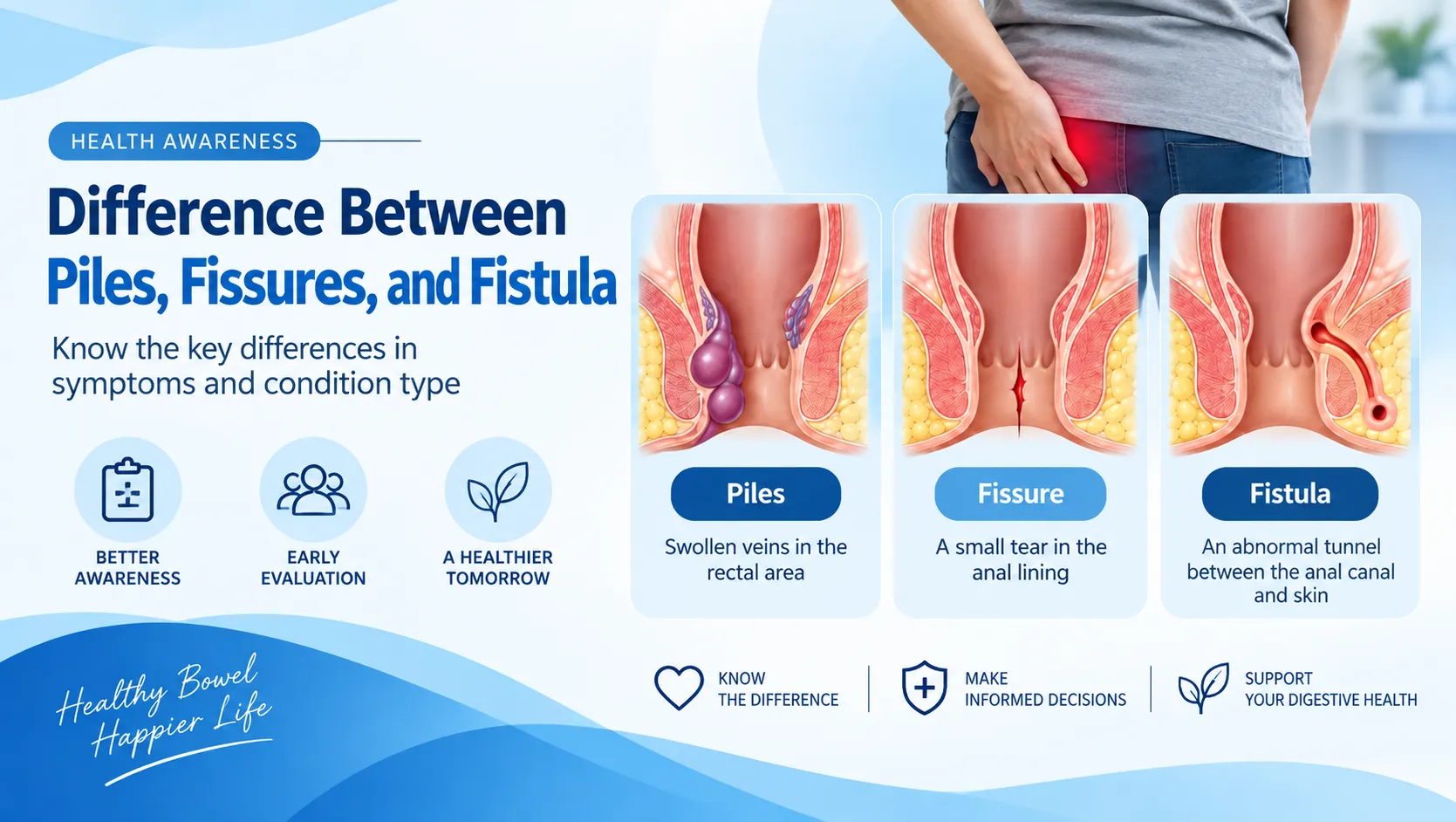
Piles, fissures, and fistulas are different anorectal conditions affecting the anal region, but they have unique physical structures, symptoms, and treatments. Because they occur in the same area, people often confuse one condition with another, especially when symptoms such as bleeding, pain, swelling, itching, or a lump are present.
In simple terms, piles are swollen blood vessels, an anal fissure is a small tear in the anal lining, and an anal fistula is an abnormal tunnel that usually develops after an infection or abscess. Understanding these differences can help you recognize the symptoms more clearly and know when medical evaluation may be needed.
Piles, Fissure or Fistula? Start With the Main Symptom
Although all three affect the area around the anus, the symptoms usually feel different.
|
Condition |
What is happening? |
What you may notice most |
|
Piles |
Blood vessels become swollen |
Bleeding, itching, swelling or a lump |
|
Fissure |
A small tear develops in the anal skin |
Sharp pain while passing stool and fresh blood |
|
Fistula |
A small tunnel forms between the inside of the anus and the nearby skin |
Repeated swelling, pain, and pus or fluid discharge |
This is only a general guide. Symptoms can overlap, so you cannot always know the exact problem just by looking at the symptoms.
Piles: Usually More About Bleeding, Itching or a Lump
Piles, also known as hemorrhoids, are swollen blood vessels that are located close to the area of the. They may develop if there is pressure that continues to be applied to the anus, in particular due to constipation, straining while toileting, using the toilet, as well as during pregnancy.
Some people have internal piles that develop within the anus. Other people have external piles which form under the skin surrounding the anus.
The symptoms could be:
-
Fresh red blood as it travels through stool
-
Itching or irritation
-
A lump in the area of the anus
-
Swelling
-
The discomfort can be felt while sitting
-
Pain, especially in external piles
One of the things that can confuse people is the fact that they are bleeding. If you notice a tiny amount of red blood, that is fresh. You might think that it's a pile. However, bleeding can occur due to a fissure or other ailments. Therefore, bleeding that is repeated should not be viewed as a pile.
Fissure: The Small Tear That Can Cause a Lot of Pain
An anal fissure can be described as tiny cuts or tears within the skin near the site of the anus.
It usually occurs after the passage of a hard or large stool. Diarrhoea can frequently irritate the region. This is the reason why those suffering from constipation frequently experience fissures.
The most interesting aspect of fissures could be the fact that the tear can be tiny; however, the pain may be intense.
A person who has a fissure might feel:
-
Sharp pain when passing stool
-
Pain that is burning or cutting
-
Pain that persists after you use the toilet
-
A couple of streaks of fresh blood on the toilet or stool paper
-
Itching or irritation
-
Sometimes, a tiny lump of skin appears near the tear.
The discomfort after passing stool is among the indicators that create a distinct fissure from other piles. People describe it as an intense, tearing or burning pain that may last for a few minutes or days.
This could also lead to an unending cycle. Since passing stool hurts the person, they may begin keeping it inside. The stool becomes more difficult to pass, and the next stool movement could hurt more.
Fistula: Think of a Repeatedly Draining Wound
Fistulas differ from piles and fissures.
It is a simple term: it's a tiny tunnel that is formed between the inner anus and the outer skin. It typically begins when an infection in the area of the anus causes a build-up of pus, referred to as an abscess. After the abscess has drained or heals on its own or following treatment, a slit may remain.
This is the reason why symptoms of a fistula are often temporary.
You may notice:
-
A painful swelling in the anus
-
A tiny opening within the skin
-
Fluid or pus coming out of the opening
-
Bad-smelling discharge
-
Itching or redness
-
The pain will improve after the swelling has gone away
-
Multiple swellings in the same spot
Many people state, "The swelling came, it burst, pus came out, and I felt better." If this continues happening in the same location, the problem should not be considered a boil or piles. It could be a sign of a fistula in the anal.
So, How Are Piles, Fissure and Fistula Different?
Think about what you are actually experiencing.
Mostly bleeding or itching? Piles could be one possible cause.
Sharp pain every time you pass stool? A fissure is more likely.
A swelling that keeps coming back or a wound that keeps leaking pus? A fistula needs to be considered.
But there is an important catch: you should not diagnose yourself only from these symptoms. Piles can sometimes be painful, fissures can bleed, and an infected fistula can cause significant pain and swelling. A doctor may need to examine the area to know exactly what is going on.
Why Do People Often Confuse These Three?
There is a simple reason: all three problems occur in the same sensitive area.
Constipation can also play a role in more than one condition. For example, repeatedly passing hard stool and straining can contribute to piles and can also cause a fissure.
A fistula is different because infection and an abscess are usually involved.
This is also why using the same cream or home remedy for every anal problem may not solve the actual problem. What helps with piles may not treat a fistula, and a fistula may need a completely different approach.
Can Piles, Fissure and Fistula Happen at the Same Time?
Yes, it is possible to suffer from more than one ailment at a time.
This means, for instance, that somebody with chronic constipation might suffer from piles due to continuous straining and fissures because of the passage of hard stools.
The other ailment which might develop independently, especially following infections in the area, would be a fistula.
Hence, if you have been suffering from piles for quite some time now and start experiencing pain and swelling or any kind of discharge, do not presume that your piles have worsened.
How Does a Doctor Find Out Which One You Have?
The doctor will first ask about what you are experiencing.
For example:
-
Is there bleeding?
-
Does it hurt while passing stool?
-
Does the pain continue afterwards?
-
Is there a lump?
-
Is there pus or fluid?
-
Does the swelling keep coming back?
-
How long have you had the problem?
A physical examination of the area is often enough to understand the problem. If a fistula is suspected, especially when it is deeper or more complicated, the doctor may recommend additional tests or imaging to understand the path of the fistula.
The aim is not just to put a label on the problem. It is to find the right treatment.
Does the Treatment Also Differ?
Yes, and that's one of the main advantages of knowing what is important.
Treatment for piles is contingent on how severe the condition is. Increased fluids and fibre while avoiding straining, as well as the use of medications to treat symptoms, could be sufficient for mild instances. Some patients may require surgery if the piles continue to bleed, come out frequently, or don't improve.
In the case of a fissure, the aim is to ease bowel movements and avoid hard stool. Fluids, fibres, medications, and other treatments could aid in the healing of the tear. A tear that is constantly coming back or doesn't heal could require further treatment.
A fistula can be distinct. The treatment of an infection can be controlled by medicines, but a fistula that is anal usually requires surgical intervention or a procedure to correct the irregular passage. The treatment method chosen will depend on the location where the fistula lies and how it can pass through the muscles surrounding the anus.
When Should You Stop Treating It Yourself?
It is reasonable to try basic measures for occasional constipation-related discomfort, but repeated or severe symptoms should be checked.
See a doctor if you have:
-
Bleeding that keeps coming back
-
Severe pain while or after passing stool
-
A painful lump or swelling
-
Pus or fluid coming from near the anus
-
A swelling that repeatedly appears and drains
-
Fever along with anal swelling or pain
-
Symptoms that are not getting better
In particular, repeated pus discharge or a wound near the anus should not be ignored. These symptoms can occur with an anal fistula and usually need proper medical evaluation rather than repeated home treatment.
Conclusion
Piles, fissures, and fistulas may affect the same anal region, but they are different conditions and need different approaches to treatment. Piles involve swollen blood vessels, an anal fissure is a tear in the anal lining, while an anal fistula is an abnormal passage that commonly develops after an infection or abscess.
Because symptoms such as bleeding, pain, swelling, itching, or discharge can sometimes overlap, it is better not to assume that every anal problem is piles. A proper examination can help identify the exact condition and guide the right treatment. If symptoms keep returning, worsen, or do not improve, you can consult Dr. Rajesh, Best General Surgeon in Gurgaon, with over 13 years of experience, for evaluation and appropriate treatment.
Frequently Asked Questions (FAQs)
1. Can piles, fissures, and fistulas heal on their own?
Mild piles and some acute anal fissures may improve with bowel care, hydration, fibre, and prescribed treatment. An established anal fistula usually does not permanently close on its own and often needs a procedure or surgery.
2. Can an anal fissure turn into a fistula?
A typical anal fissure does not usually turn into a fistula. A fistula is more commonly linked to an anal abscess or infection. Persistent pain, swelling, or discharge should be evaluated separately.
3. Can piles turn into a fistula?
No, piles do not normally turn into a fistula because they are different conditions. Piles involve swollen veins, while a fistula is an abnormal tract usually related to infection.
4. Which is more serious: piles, fissure, or fistula?
The seriousness depends on the severity and complications. Mild piles or fissures may improve with conservative care, while a fistula often requires more specific treatment because the abnormal tract can persist or become infected again.
5. Can piles or fissures come back after treatment?
Yes. Recurrence can happen, especially if constipation, hard stools, prolonged straining, or poor bowel habits continue. Following dietary and bowel-care advice may help reduce the risk.
6. Can an anal fistula come back after surgery?
Yes, recurrence is possible in some cases, particularly with complex fistulas. The risk depends on the fistula tract, its relationship with the anal muscles, and the type of treatment used.
7. Can I exercise if I have piles, fissure, or fistula?
Light physical activity is generally possible, but activities that increase pain, pressure, or straining may need to be reduced temporarily. The right level of activity depends on the condition and its severity.
8. Does sitting for long hours make piles, fissures, or fistulas worse?
Long periods of sitting may increase discomfort in some people, particularly when there is swelling, inflammation, or pain. Taking short movement breaks can help reduce prolonged pressure on the anal region.
9. Are piles, fissures, or fistulas contagious?
No. These conditions do not spread from one person to another through touch, shared toilets, or normal contact.
10. Can piles, fissures, or fistulas affect bowel control?
Most uncomplicated cases do not affect bowel control. However, complex fistulas or certain surgical procedures can involve muscles responsible for continence, which is why treatment planning should be individualized and performed carefully.