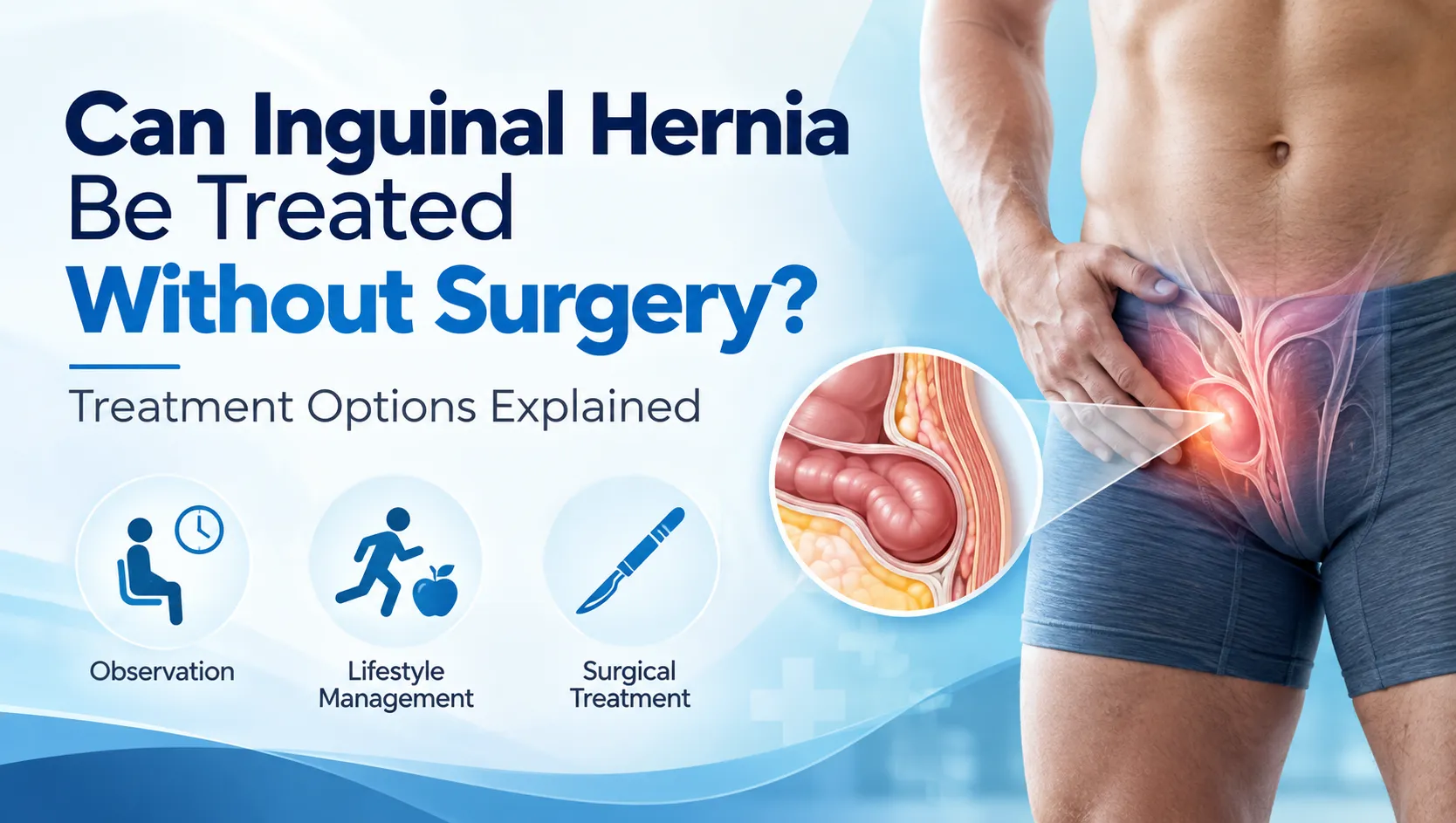
An inguinal hernia cannot be cured or permanently healed without surgery, because the physical tear or weakness in the abdominal muscle wall will not repair itself. However, this does not mean that every person with an inguinal hernia needs immediate surgery.
In some patients with a small hernia and little or no discomfort, a surgeon may recommend watchful waiting and regular follow-up. Measures such as avoiding heavy lifting, preventing constipation, maintaining a healthy weight, and treating chronic cough may help reduce symptoms, but they do not close the hernia defect. Surgery may be considered when the hernia becomes painful, increases in size, interferes with daily activities, or causes complications.
What Is an Inguinal Hernia?
An inguinal hernia occurs when fatty tissue or part of the intestine pushes through a weak area in the lower abdominal wall, usually around the groin.
It may appear as a lump or swelling that becomes more noticeable while:
-
Standing
-
Coughing
-
Sneezing
-
Lifting something heavy
-
Straining during bowel movements
-
Exercising
The swelling may become smaller or disappear when lying down, especially during the early stages.
Inguinal hernias are more common in men, although women can also develop them.
Can an Inguinal Hernia Be Treated Without Surgery?
An inguinal hernia may sometimes be managed without immediate surgery, but it cannot usually be permanently repaired without an operation.
For people with very mild or no symptoms, a surgeon may recommend watchful waiting. This means monitoring the hernia and having it reviewed if symptoms change.
Non-surgical management may include:
-
Avoiding unnecessary heavy lifting
-
Preventing constipation
-
Maintaining a healthy body weight
-
Treating chronic cough
-
Learning safer lifting techniques
-
Monitoring the size of the hernia
-
Regular surgical follow-up
These measures may reduce pressure on the abdominal wall, but they do not close the hernia defect.
Can an Inguinal Hernia Heal on Its Own?
No. In adults, an inguinal hernia generally does not heal naturally.
The problem occurs because there is a weakness or opening in the abdominal wall. Once this weakness has developed, the body's tissues usually do not close it by themselves.
A hernia may appear to disappear when a person lies down or gently pushes the swelling back inside. This is known as a reducible hernia.
However, the underlying weakness is still present, so the lump can appear again while standing, coughing, exercising, or straining.
Can Medicines Cure an Inguinal Hernia?
Medicines cannot repair an inguinal hernia.
A doctor may prescribe medicines for associated problems such as:
-
Pain or discomfort
-
Constipation
-
Chronic cough
-
Acidity or digestive symptoms
Treating these problems may reduce strain on the abdominal wall and make the patient more comfortable.
However, medicines cannot close the opening through which the tissue is protruding.
Can Exercise Fix an Inguinal Hernia?
Exercise cannot close an existing inguinal hernia.
Maintaining general fitness and a healthy weight can be beneficial, but exercises that significantly increase pressure inside the abdomen may make the swelling or discomfort more noticeable.
People with an inguinal hernia should be cautious with:
-
Heavy weightlifting
-
Forceful abdominal exercises
-
Straining
-
Activities that clearly increase groin pain
The appropriate level of activity depends on the size of the hernia and the symptoms.
Can Weight Loss Help an Inguinal Hernia?
Weight loss may help reduce pressure on the abdominal wall in people who are overweight, which can reduce discomfort and may make future surgery easier.
However, losing weight does not repair the hernia defect.
If an inguinal hernia is causing persistent symptoms, weight loss alone should not be considered a permanent treatment.
Does a Hernia Belt or Truss Treat an Inguinal Hernia?
A hernia belt or truss may temporarily support the groin area and reduce the feeling of bulging in some people.
However, it does not repair the abdominal wall weakness.
Improper use can also cause discomfort or make it difficult to recognize changes in the hernia.
A hernia belt should therefore not be considered a substitute for medical evaluation or surgery when surgery is indicated.
What Is Watchful Waiting for an Inguinal Hernia?
Watchful waiting means that surgery is not performed immediately, and the patient is monitored for changes in symptoms.
It may be considered in selected adults, particularly some men with a hernia that causes little or no discomfort.
During watchful waiting, patients are usually advised to monitor for:
-
Increasing pain
-
Increase in the size of the lump
-
Difficulty pushing the hernia back
-
Limitation of normal activities
-
Nausea or vomiting
-
Sudden severe groin pain
Many people who initially choose observation may eventually undergo surgery if symptoms develop or worsen.
When Is Inguinal Hernia Surgery Recommended?
Surgery may be considered when an inguinal hernia starts causing significant symptoms or creates a risk of complications.
Common reasons include:
-
Persistent groin pain
-
Pain while walking or exercising
-
Increasing hernia size
-
Discomfort while coughing or lifting
-
Difficulty performing daily activities
-
Hernia that is becoming difficult to push back inside
-
Recurrent episodes of pain
-
Concern about incarceration or strangulation
The decision is made after evaluating the patient's symptoms, age, health, hernia size, and lifestyle.
What Happens If an Inguinal Hernia Is Left Untreated?
Some inguinal hernias may remain relatively stable for a long time, while others gradually become larger or more symptomatic.
Possible problems include:
Increasing Size
The hernia may gradually become more prominent, particularly while standing or straining.
Increasing Pain
A previously painless hernia may start causing aching, pulling, burning, or heaviness in the groin.
Incarceration
The tissue inside the hernia can sometimes become trapped and may no longer move back into the abdomen.
Strangulation
In some cases, the blood supply to trapped intestinal tissue can become restricted. This is a medical emergency and may require urgent surgery.
Not every untreated hernia develops these complications, but sudden changes should not be ignored.
What Are the Warning Signs of a Complicated Inguinal Hernia?
Seek urgent medical attention if an inguinal hernia is associated with:
-
Sudden severe groin or abdominal pain
-
A painful lump that cannot be pushed back
-
Rapidly increasing swelling
-
Redness or marked tenderness over the swelling
-
Repeated vomiting
-
Severe abdominal bloating
-
Inability to pass stool or gas
-
Fever
These symptoms may indicate obstruction or strangulation.
What Are the Surgical Treatment Options for Inguinal Hernia?
If surgery is recommended, the aim is to return the protruding tissue to its proper position and repair the weakness in the abdominal wall.
The main approaches include:
Open Inguinal Hernia Repair
In open surgery, the surgeon makes an incision in the groin to access the hernia.
The protruding tissue is placed back into the abdomen, and the weak area is repaired. Mesh may be used to reinforce the abdominal wall in appropriate patients.
Open repair may be suitable for many different types of inguinal hernia.
Laparoscopic Inguinal Hernia Repair
Laparoscopic surgery is performed through several small incisions.
A camera and specialized instruments are used to repair the hernia from inside the abdominal wall.
Possible advantages in appropriately selected patients can include:
-
Smaller incisions
-
Less wound discomfort
-
Earlier return to routine activities
-
Ability to assess both groins
-
Useful option for some recurrent or bilateral hernias
The most suitable technique depends on the patient's condition and the surgeon's assessment.
Robotic Inguinal Hernia Repair
Robotic-assisted hernia repair uses a surgeon-controlled robotic system.
The surgeon remains in complete control of the procedure while operating through small incisions.
The system can provide enhanced visualization and flexible instrument movement, which may be useful in selected cases.
Robotic surgery is not necessary for every inguinal hernia. The decision should depend on the type of hernia, previous surgeries, patient factors, and surgical judgment.
Is Mesh Always Used for Inguinal Hernia Surgery?
Mesh is commonly used in adult inguinal hernia repair because it helps reinforce the weakened area of the abdominal wall.
However, treatment is individualized.
The choice of:
-
Mesh repair
-
Non-mesh repair
-
Open surgery
-
Laparoscopic surgery
-
Robotic-assisted surgery
depends on the patient's age, hernia type, previous operations, health conditions, and other clinical factors.
Is Inguinal Hernia Surgery Painful?
Some pain or discomfort is expected after any operation.
After inguinal hernia surgery, patients may experience:
-
Soreness around the incision
-
Mild swelling
-
Tightness
-
Bruising
-
Temporary discomfort while walking or changing position
Pain generally improves during recovery, but the amount of discomfort varies between patients and surgical techniques.
Doctors may prescribe appropriate pain medication during recovery.
How Long Does Recovery Take After Inguinal Hernia Surgery?
Recovery time varies depending on:
-
Type of surgery
-
Size of the hernia
-
Patient's age
-
General health
-
Nature of work
-
Whether complications were present
Many patients are encouraged to start walking soon after surgery.
Light activities may be resumed gradually, while strenuous exercise and heavy lifting may need to be restricted for a period recommended by the surgeon.
Patients should follow their own postoperative instructions rather than comparing recovery timelines with others.
Can an Inguinal Hernia Return After Surgery?
An inguinal hernia can recur after repair, although modern surgical techniques are designed to reduce this risk.
Factors that may contribute to recurrence include:
-
Smoking
-
Obesity
-
Chronic cough
-
Persistent constipation
-
Heavy strain
-
Poor tissue quality
-
Previous hernia repairs
-
Certain medical conditions
Following postoperative guidance can help support recovery.
How Can You Prevent an Inguinal Hernia From Getting Worse?
Although these measures cannot cure an existing hernia, they may help reduce unnecessary strain:
-
Avoid lifting very heavy objects unnecessarily
-
Use proper lifting technique
-
Prevent constipation
-
Maintain a healthy body weight
-
Treat persistent cough
-
Avoid smoking
-
Stay physically active within comfortable limits
-
Seek assessment if the swelling increases
Which Doctor Treats an Inguinal Hernia?
An inguinal hernia is usually evaluated and treated by a General Surgeon or a surgeon experienced in hernia and minimally invasive surgery.
The surgeon examines the groin and may sometimes advise imaging if the diagnosis is uncertain.
The purpose of the consultation is not automatically to schedule surgery. It is to determine:
-
Whether the swelling is actually a hernia
-
How large it is
-
Whether it is causing symptoms
-
Whether observation is appropriate
-
Whether surgery should be considered
-
Which surgical technique may be suitable
Conclusion
An inguinal hernia cannot usually be permanently cured without surgery because the weakness in the abdominal wall does not heal on its own. However, immediate surgery is not necessary for every patient. Some people with a small and minimally symptomatic hernia may be managed with observation and regular follow-up.
Lifestyle changes, weight management, constipation prevention, and avoiding excessive strain can help control symptoms, but they do not repair the hernia.
If the hernia becomes painful, grows in size, interferes with daily activities, becomes difficult to push back, or causes vomiting or severe abdominal symptoms, surgical evaluation is important.
For the evaluation and treatment of inguinal hernia, patients can consult Dr. Rajesh ,General Surgeon in Gurgaon, to discuss whether observation, open repair, laparoscopic surgery, or robotic-assisted surgery is appropriate.
Frequently Asked Questions
1. Can a small inguinal hernia disappear naturally?
An adult inguinal hernia generally does not disappear permanently because the underlying weakness in the abdominal wall remains, even if the swelling becomes less visible while lying down.
2. How long can you live with an inguinal hernia without surgery?
There is no fixed time. Some minimally symptomatic hernias may be monitored, while others become painful or larger. Regular assessment is important if surgery is being delayed.
3. Can an inguinal hernia be pushed back inside?
Some hernias are reducible and can move back inside while lying down or with gentle pressure. This does not mean the hernia is cured.
4. Can walking make an inguinal hernia worse?
Normal walking is often tolerated, but activities that clearly increase pain or swelling should be modified. Individual advice depends on the size and symptoms of the hernia.
5. Can an inguinal hernia affect the testicle?
A large inguinal hernia may extend into the scrotum and cause swelling or discomfort. Any new testicular or scrotal swelling should be medically evaluated.
6. Is an inguinal hernia dangerous?
Many inguinal hernias are not immediately dangerous. However, a trapped or strangulated hernia can become an emergency, particularly when associated with severe pain, vomiting, or an irreducible swelling.
7. Does an inguinal hernia always get bigger?
Not every hernia grows at the same rate, but some gradually increase in size over time. Changes in size or symptoms should be reviewed by a surgeon.
8. Can constipation make an inguinal hernia worse?
Repeated straining during bowel movements increases abdominal pressure and may make an existing hernia more noticeable or uncomfortable. Managing constipation can therefore be helpful.
9. Can I go to the gym with an inguinal hernia?
Activity depends on symptoms. Heavy lifting or exercises that cause groin pain or increase the bulge may need to be avoided until the hernia has been assessed.
10. When should an inguinal hernia be treated urgently?
Urgent evaluation is required for sudden severe pain, vomiting, marked tenderness, abdominal swelling, or a hernia lump that becomes painful and cannot be pushed back inside.