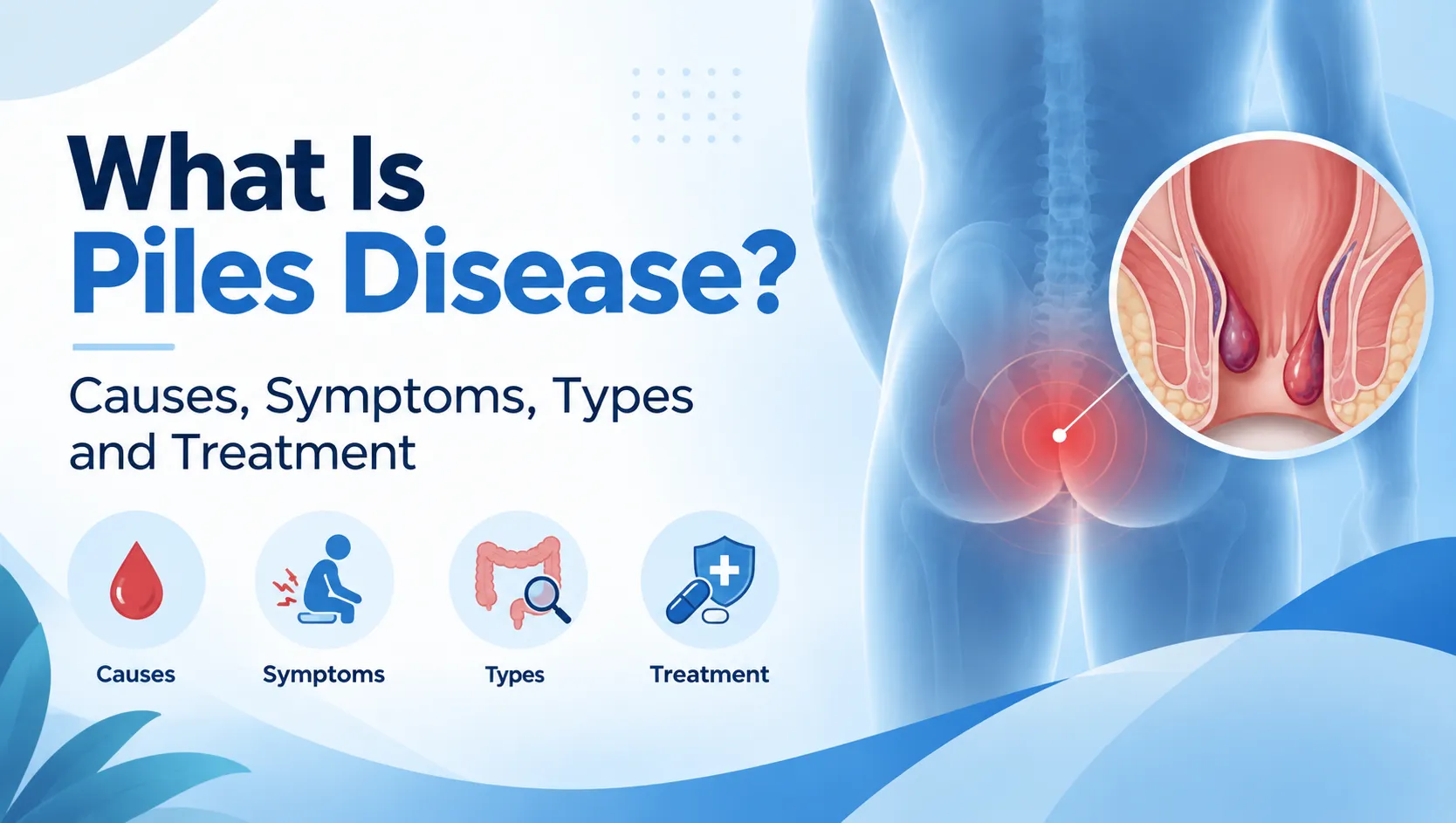
Piles, also known as hemorrhoids, are swollen blood vessels in or around the anus and lower rectum. They can cause fresh red bleeding during bowel movements, itching, swelling, discomfort, or a lump near the anus. Piles are commonly linked with constipation, repeated straining, pregnancy, prolonged toilet sitting, and increased pressure in the anal region.
Piles may be internal or external. Internal piles often cause painless bleeding, while external piles are more likely to cause pain, tenderness, or swelling.
This article explains what piles disease is, its causes, symptoms, types, stages, treatment options, and when you should see a doctor.
What Is Piles Disease?
Piles are swollen blood vessels located in the lower rectum or around the anus. The medical term for piles is hemorrhoids.
Blood vessels normally exist in this area and help with bowel control. Problems may develop when these tissues become enlarged, swollen, irritated, or begin to protrude.
Piles can develop:
-
Inside the rectum
-
Around the opening of the anus
-
Or in both areas
The symptoms and treatment can vary depending on the type and severity of piles.
What Causes Piles?
Piles generally develop when repeated pressure is placed on the veins and supporting tissues around the anus.
Some common causes and risk factors for piles include:
1. Chronic Constipation
Passing hard stool repeatedly can make a person strain during bowel movements. This increases pressure around the anal veins and may contribute to hemorrhoids.
2. Straining While Passing Stool
Frequent or prolonged straining increases pressure inside the anal canal, which can contribute to swelling of hemorrhoidal tissue.
3. Sitting on the Toilet for a Long Time
Spending excessive time on the toilet may increase pressure in the anal area.
Using a mobile phone while sitting on the toilet for long periods can unintentionally prolong bowel movements.
4. Low-Fibre Diet
A diet low in fibre can make stools harder and more difficult to pass, increasing the chances of constipation and straining.
5. Pregnancy
During pregnancy, increased pressure in the abdomen and hormonal changes can make piles more likely.
Some women may also experience hemorrhoids after delivery because of straining during childbirth.
6. Being Overweight
Excess body weight may increase pressure on the pelvic and rectal veins, contributing to hemorrhoidal symptoms in some people.
7. Heavy Lifting
Repeated heavy lifting can increase intra-abdominal pressure, particularly when accompanied by straining.
8. Ageing
As people age, the tissues supporting the veins in the rectum and anus can become weaker, making hemorrhoids more likely to develop or prolapse.
9. Chronic Diarrhoea
Although constipation is commonly associated with piles, frequent diarrhoea and repeated bowel movements can also irritate the anal area and contribute to symptoms.
What Are the Symptoms of Piles?
Piles symptoms vary depending on whether the hemorrhoids are internal or external.
Common symptoms include:
-
Fresh red blood during or after passing stool
-
Blood on toilet paper
-
Itching around the anus
-
Irritation or burning
-
A lump near the anus
-
Swelling
-
Mucus discharge
-
Feeling that the bowel has not emptied completely
-
Discomfort while sitting
-
Pain in some cases
Bleeding from piles is usually bright red, but rectal bleeding should not automatically be assumed to be piles because other conditions can also cause bleeding.
What Are the Types of Piles?
Piles are mainly divided into two types:
1. Internal Piles
Internal piles develop inside the rectum and may not be visible from outside.
They often cause:
-
Painless bleeding
-
Mucus discharge
-
A feeling of incomplete bowel movement
-
Tissue coming out during bowel movements in more advanced cases
Internal piles are further classified according to their degree of prolapse.
2. External Piles
External piles develop under the skin around the anus.
They may cause:
-
Swelling
-
Itching
-
Tenderness
-
Pain
-
A lump near the anus
If a blood clot develops inside an external hemorrhoid, it is known as a thrombosed external hemorrhoid, which may cause sudden and significant pain.
What Are the Grades of Piles?
Internal piles are commonly classified into four grades.
Grade 1 Piles
The hemorrhoids remain inside the anal canal and do not come outside.
Bleeding may be the main symptom.
Grade 2 Piles
The piles come outside during bowel movements but go back inside on their own.
Grade 3 Piles
The piles come outside during bowel movements and may need to be gently pushed back inside.
Grade 4 Piles
The hemorrhoidal tissue remains outside and cannot easily be pushed back inside.
Higher-grade piles may be more likely to require procedural or surgical treatment, although treatment always depends on symptoms and individual assessment.
What Is the Difference Between Internal and External Piles?
|
Internal Piles |
External Piles |
|
Develop inside the rectum |
Develop around the anus |
|
Often cause painless bleeding |
Can be painful or tender |
|
May prolapse in advanced stages |
May appear as a visible lump |
|
Usually not visible initially |
Often visible or felt |
|
Classified into Grades 1–4 |
Not classified using the same grading system |
Do Piles Always Cause Pain?
No.
Internal piles, especially in the early stages, can cause bleeding without significant pain.
Pain is more likely when:
-
External piles become swollen
-
A blood clot develops
-
Prolapsed piles become irritated
-
Another problem such as an anal fissure is present
Severe pain during bowel movements may sometimes suggest a fissure rather than uncomplicated internal piles.
How Are Piles Diagnosed?
Diagnosis usually begins with a discussion of symptoms and an examination.
The doctor may ask:
-
How long has bleeding been present?
-
Is the blood bright red or dark?
-
Is passing stool painful?
-
Is there a lump?
-
Does the lump go back inside?
-
Is constipation present?
-
Have bowel habits recently changed?
Depending on the symptoms, examination may include inspection of the anal region and, when appropriate, a rectal or proctoscopic examination.
Further tests may be advised if another cause of bleeding needs to be ruled out.
Can Piles Be Cured Without Surgery?
Many mild or early-stage piles can be managed without surgery.
Treatment often begins with measures aimed at reducing constipation and straining.
These may include:
-
Increasing dietary fibre
-
Drinking adequate fluids
-
Avoiding prolonged toilet sitting
-
Avoiding excessive straining
-
Staying physically active
-
Treating constipation when present
-
Using prescribed creams or medicines for short-term symptom relief
However, these measures may control symptoms rather than remove larger or prolapsing hemorrhoids.
Persistent or advanced piles may need a procedure.
What Is the Treatment for Piles?
The right piles treatment depends on the type, grade, severity of symptoms, and whether conservative treatment has helped.
1. Diet and Lifestyle Changes
Fibre helps make stool softer and easier to pass.
Useful sources include:
-
Fruits
-
Vegetables
-
Whole grains
-
Pulses
-
Oats
-
Other fibre-rich foods
Adequate fluids are also important.
Increasing fibre suddenly may cause bloating, so it is usually better to increase it gradually.
2. Medicines
A doctor may recommend medicines depending on the symptoms.
These can include treatment for:
-
Constipation
-
Pain or discomfort
-
Local irritation
-
Inflammation
Medicines should be used according to medical advice, especially when bleeding is persistent.
3. Rubber Band Ligation
Rubber band ligation is an office-based procedure used for selected internal hemorrhoids.
A small band is placed around the hemorrhoidal tissue, reducing its blood supply so that the tissue eventually shrinks and separates.
It is not suitable for every type of piles.
4. Injection or Other Office Procedures
Some internal piles can be treated with techniques such as injection therapy or coagulation-based procedures.
The appropriate treatment depends on the grade and clinical findings.
What Is Laser Piles Surgery?
Laser treatment is one of the procedural options available for selected patients with hemorrhoids.
In techniques such as laser hemorrhoidoplasty, laser energy may be used to shrink hemorrhoidal tissue.
Potential benefits in appropriately selected patients may include a minimally invasive approach and, in some cases, less postoperative discomfort. However, laser treatment is not automatically the best option for every patient or every grade of piles.
The choice between laser treatment, conventional hemorrhoidectomy, stapled procedures, banding, or another technique should depend on:
-
Grade of piles
-
Size and location
-
External component
-
Severity of bleeding
-
Prolapse
-
Previous treatment
-
Overall health
A surgeon can recommend the most suitable option after examination.
When Is Surgery Needed for Piles?
A procedure or surgery may be considered when:
-
Bleeding keeps returning
-
Piles repeatedly come outside
-
Grade 3 or Grade 4 prolapse causes symptoms
-
Conservative treatment does not help
-
Large external hemorrhoids cause problems
-
Symptoms significantly interfere with daily activities
-
Complications develop
Having piles does not automatically mean that surgery is necessary.
What Should You Eat If You Have Piles?
The main goal is to keep stools soft and reduce straining.
Include foods such as:
-
Green vegetables
-
Fruits
-
Whole grains
-
Oats
-
Pulses
-
Fibre-rich cereals
-
Adequate fluids
If constipation is persistent, dietary changes alone may not be enough and medical advice may be required.
Are Piles and Fissure the Same?
No.
Piles are swollen blood vessels, while an anal fissure is a small tear in the lining of the anus.
A fissure commonly causes sharp or burning pain during and after passing stool.
Piles may cause bleeding, itching, swelling, or a lump and may be painless, especially when internal.
Because symptoms can overlap, examination may be necessary.
Are Piles and Fistula the Same?
No.
A fistula is an abnormal tunnel that usually forms between the anal canal and nearby skin following an infection or abscess.
Repeated swelling, pus discharge, and a small opening near the anus are more suggestive of a fistula than uncomplicated piles.
When Should You See a Doctor for Piles?
Medical evaluation is recommended if you experience:
-
Repeated rectal bleeding
-
Significant anal pain
-
A persistent or growing lump
-
Heavy bleeding
-
Black or tar-like stools
-
Unexplained weight loss
-
Changes in bowel habits
-
Weakness or symptoms of anaemia
-
Fever or pus discharge
-
Symptoms that do not improve
Black stools, heavy bleeding, dizziness, or severe worsening symptoms require prompt medical attention.
Can Rectal Bleeding Always Be Piles?
No.
Although piles are a common cause of bright red rectal bleeding, other conditions can also cause blood in the stool.
These may include:
-
Anal fissure
-
Inflammatory bowel disease
-
Polyps
-
Diverticular disease
-
Colorectal cancer
-
Other gastrointestinal conditions
This is why persistent or unexplained rectal bleeding should be medically evaluated rather than self-diagnosed as piles.
Conclusion
Piles are a common anorectal condition, but the symptoms and severity can vary from person to person. While mild cases may improve with better bowel habits, adequate fibre, enough fluids, and appropriate medicines, recurring bleeding, prolapse, persistent discomfort, or a lump may need further evaluation and treatment.
The right treatment depends on the type and grade of piles, severity of symptoms, and response to conservative care. In some cases, procedures such as banding, laser treatment, or surgery may be considered.
If piles symptoms keep returning or do not improve, it is important to get the correct diagnosis rather than continuing self-treatment. You can consult Dr. Rajesh, Best General Surgeon in Gurgaon, with over 13 years of experience, for evaluation and a treatment plan based on your condition.
Frequently Asked Questions About Piles Disease
1. Can Piles Go Away on Their Own?
Mild piles may improve with better bowel habits, adequate fluids, fibre, and reduced straining. However, persistent bleeding, prolapse, or recurring symptoms may need medical treatment.
2. Can Piles Come Back After Treatment?
Yes. Piles can recur after treatment, particularly if constipation, repeated straining, prolonged toilet sitting, or other contributing factors continue. Maintaining healthy bowel habits may help reduce the risk of recurrence.
3. Is Piles Hereditary?
Piles are not inherited in a simple way, but some people may have a greater tendency because of family-related tissue characteristics, bowel habits, or lifestyle factors.
4. Can Piles Turn Into Cancer?
No. Piles do not turn into cancer. However, rectal bleeding can also occur with other conditions, including colorectal cancer, so persistent or unexplained bleeding should be evaluated.
5. How Long Do Piles Usually Last?
The duration depends on the type and severity of piles. Mild symptoms may improve within days or weeks, while prolapsing or advanced hemorrhoids may persist until appropriately treated.
6. Is Laser Treatment for Piles Permanent?
Laser treatment can effectively treat selected hemorrhoids, but no treatment can guarantee that piles will never return. Recurrence depends on the type of piles, treatment used, and ongoing factors such as constipation and straining.
7. Can Piles Cause Anaemia?
Repeated or significant bleeding from piles can occasionally lead to iron-deficiency anaemia. Persistent bleeding, weakness, fatigue, or dizziness should be medically evaluated.
8. Can Piles Affect Pregnancy or Delivery?
Piles are relatively common during pregnancy because of increased pelvic pressure and constipation. Symptoms often improve after delivery, although persistent or severe problems should be discussed with a doctor.
9. Can Piles Affect Your Daily Bowel Movements?
Larger or prolapsing piles may cause discomfort, irritation, mucus discharge, or a sensation of incomplete bowel emptying. Significant changes in bowel habits should not automatically be assumed to be caused by piles.
10. Which Doctor Should I Consult for Piles?
A general surgeon or colorectal surgeon can evaluate piles, determine their type and severity, and recommend conservative, office-based, laser, or surgical treatment when appropriate.